
Reviewed · FOOD TOURS IN SOFIA
Sofia Food & Tasting Tour with Communist-Era Tram Ride
Sofia’s best introduction may be a walk that keeps one hand on a plate and the other on the city’s past. This three-hour tour with Peter links five food stops to Roman ruins, Orthodox churches, a mosque, a synagogue, a market, and a ride on a communist-era tram.
I like the way the tour mixes ordinary local eating with major sights, and I like that Peter can adjust the route for a solo participant or a small group. The food is generous, with Bulgarian beer, local wine, sausages, cheese, salad, appetizers, and dessert all included.
The main caution is pace. You cover a good part of central Sofia in about three hours, and the tour includes walking plus travel between stops. If you want a slow, detailed visit inside every monument, this is not that tour.
Key points at a glance
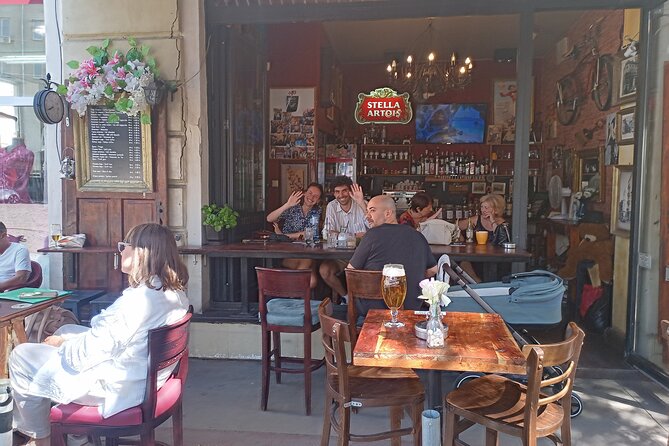
- Five tastings with drinks included: Expect traditional meals, salad, snacks, dessert, Bulgarian beer, and a glass of local wine.
- A city tour with real historical range: The route reaches Roman Serdica, medieval and Ottoman-era sites, modern Sofia, and communist-era culture.
- Peter is the guide to know: He brings personal local perspective, explains architecture and history, and offers practical ideas for the rest of your stay.
- Small groups make a difference: The maximum group size is 11, and private-feeling tours may be possible when only a few people book.
- A tram ride offers a break from the pavement: This is especially useful on a hot day, though the exact tram route is not specified.
- Best taken early in your Sofia visit: You will get a useful map of the center and several restaurant and bar ideas for later.
Why this food tour works as a first day in Sofia
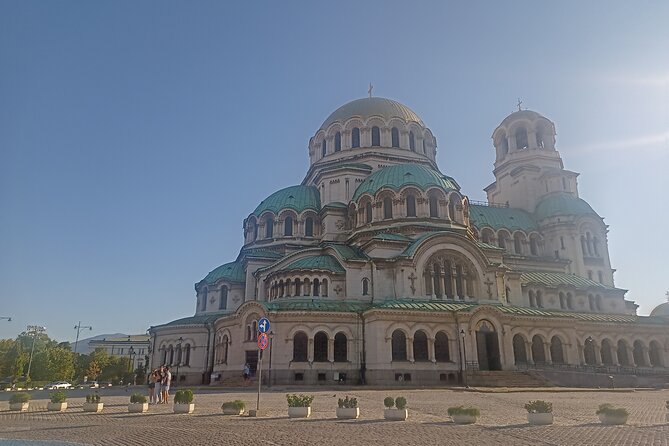
Many food walks give you a few bites and little sense of place. This one uses the food as a thread through Sofia’s center. You begin at the Patriarchal Cathedral of St. Alexander Nevsky and finish below the Central Market Hall, with landmarks and local eating woven together between the two.
Peter is the key part of that design. He does not only point at buildings. He explains architecture, major events, the communist period, and the way Sofia’s past still affects daily life. He also knows how to change the plan when needed. If you have already seen one of the main sights, he may spend more time elsewhere.
The group limit of 11 keeps the outing from feeling like a moving crowd. A small group also works well for food sharing, since you can compare flavors and ask what each dish is. Solo bookings may feel especially personal. One person received an adjusted route, while a two-person booking had the kind of flexible attention that can be hard to get on a large city walk.
You should arrive hungry. The meal begins with Bulgarian traditional sausages, cheese, and wine or beer, and the experience continues through five food stops. One especially useful tip is to skip breakfast, since the portions can leave you very full by the end.
More Food Tours in Sofia
- Wine Tasting in Heart of Sofia
★ 5.0 · 545 reviews - Wine and Tapas Boutique Bulgarian Wine Tasting
★ 5.0 · 25 reviews - Market Food Tour
★ 4.5 · 21 reviews
Alexander Nevsky Cathedral and Sofia’s grand opening
St. Alexander Nevsky Cathedral is a fitting place to begin. Its Neo-Byzantine design and huge scale make it one of Sofia’s clearest symbols. You get about 10 minutes here, with admission listed as free.
That short stop is enough to take in the outside, hear the basic story, and understand the cathedral’s place in the city. It is not enough for a slow study of every interior detail, so you should treat this as an orientation rather than a full cathedral visit.
The nearby neoclassical building designed by Viennese architect Friedrich Schwanberg was built from 1881 to 1883. Its presence helps explain the mixture you see all over Sofia: Bulgarian, Ottoman, Russian, Viennese, and modern influences often sit within a short walk of each other.
This is where Peter’s architectural explanations add value. Sofia’s center can look like a jumble of styles if you walk it alone. With a guide, the buildings become part of a story about a young capital building its public identity.
The National Library and Sofia University
The St. St. Cyril and Methodius National Library holds about 8.5 million documents, making it Bulgaria’s largest book treasury. Its old and rare collection contains roughly 17,000 books and periodicals printed from the 15th through the 21st centuries.
You spend about 10 minutes here, and temporary exhibitions may be part of the visit. The tour does not promise a long research-library visit, but even a short look gives you a sense of Bulgaria’s literary and cultural importance.
The library is close to Sofia University St. Kliment Ohridski, founded on October 1, 1888. From Monday through Friday, you may be able to see the central hall and its large stained-glass windows. Since access can depend on the day, do not build your entire schedule around seeing the interior.
This part of the route is useful because it moves beyond the standard postcard sights. You see the institutions that helped shape modern Bulgaria, not just the buildings that photograph well.
From Eagles’ Bridge to the Women’s Market
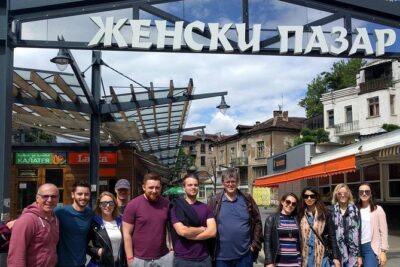
The route also touches the area around Eagles’ Bridge and the Women’s Market, known in Bulgarian as Zhenski Pazar. The market has operated for more than 140 years and is described as one of Sofia’s important trading centers, with nearly 60,000 visits on an average day.
This is a better place to think about everyday Sofia than a polished monument. Market food, local products, and the movement of shoppers help connect the tastings to ordinary city life. You may also get a clearer sense of how food sits within the wider culture, rather than treating Bulgarian dishes as isolated samples.
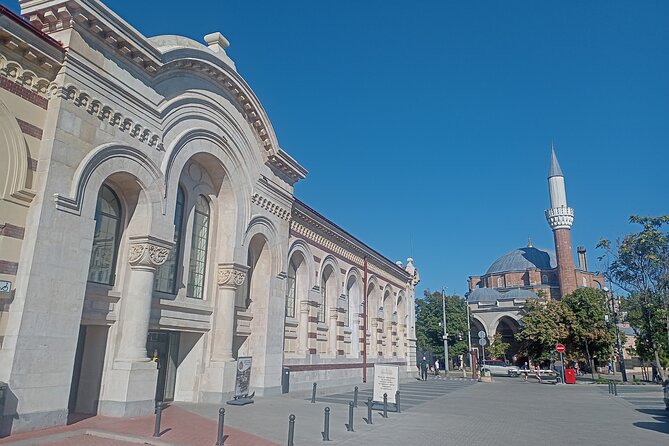
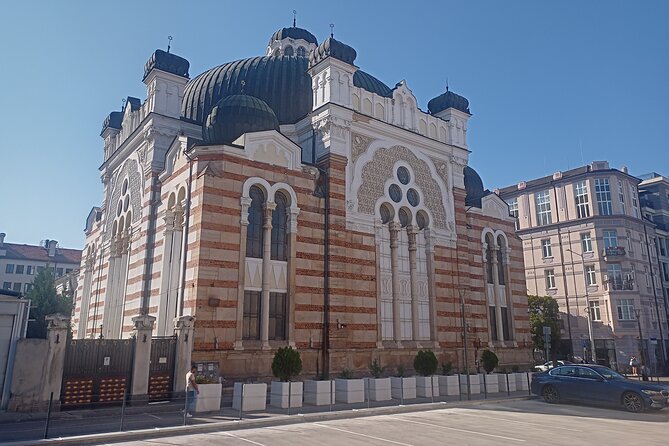
The market lies in Sofia’s so-called Area of Tolerance. Close by are the Saints Cyril and Methodius Church, Banya Bashi Mosque, and Sofia’s Central Synagogue. That concentration of religious buildings is one of the most striking features of central Sofia.
The synagogue is one of the three largest Sephardic synagogues in Europe and the largest on the Balkan Peninsula. Banya Bashi Mosque is associated with Mullah Effendi Kada Seyfullah and is credited to Ottoman architect Mimar Sinan. The number 974 above its entrance is linked to the Hijri calendar, corresponding to 1566 or 1567.
You do not get a full architectural lecture at each stop, but the short explanations help you read the city. In just a few blocks, Sofia shows Orthodox Christian, Jewish, and Muslim traditions alongside modern public buildings and market life.
More communist-era history walks:
- Communist Walking Tour of Sofia
★ 5.0 · 690 reviews - Sofia Communist History 2-Hour Tour in a Classic Trabant
★ 5.0 · 45 reviews - Buzludzha Monument and the Museum of Socialist Art
★ 5.0 · 25 reviews - Self-guided Tour in the Museum of Socialist Art
★ 4.0 · 4 reviews
Roman Serdica beneath modern Sofia
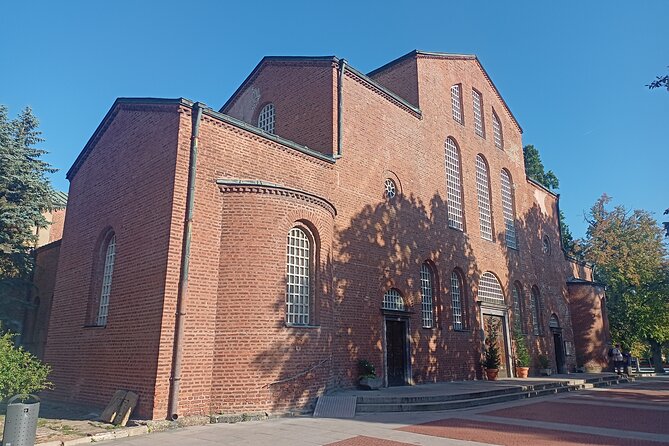
The West Gate of Sofia marks the older Roman city of Serdica. The first fortification wall was built in the second half of the second century AD. It was later rebuilt, and a ditch was added in front of the western gate during the late third or early fourth century.
A 10-minute stop here gives you a quick look at the defensive edge of the Roman settlement. The walls were substantial, about 2.20 meters wide, and the ditch measured roughly 5 meters across and 2 meters deep.
The Ancient Serdica Archaeological Complex is one of the tour’s most rewarding historical stops. Beneath Nezavisimost Square, the Largo zone incorporates Roman remains into a public cultural area. You can see part of the decumanus maximus, the main east-west street linking the city’s eastern and western gates.
A large residential building occupied a whole urban block, or insula, south of the street. It also contained small shops where residents and passing visitors could buy food and other goods. That detail pairs nicely with a food tour. The Roman city was not an abstract ruin. It was a place where people lived, shopped, ate, and moved through the streets.
Again, the time is short, about 10 minutes. You will get the layout and the key idea, but you may want to return later if Roman Sofia is a major interest. The advantage here is that you see the ruins in context, right beneath the modern center rather than in a distant archaeological park.
Mineral baths, mosque, and the city’s layers
Sofia’s natural hot springs reach about 46 degrees Celsius. The Central Mineral Baths building was designed in Vienna Secession style, with Bulgarian, Byzantine, and Eastern Orthodox decorative touches. Architects Petko Momchilov and Friedrich Grünanger created the building in 1904 and 1905, and the project was approved in 1906.
This is a good example of how Sofia resists a single label. The building looks European at first glance, but its ornament carries local and regional influences. The hot springs also remind you that Sofia’s location has shaped the city for centuries.
The nearby Banya Bashi Mosque adds another period to the route. Its connection with Mimar Sinan and its 16th-century date make it one of the most important Ottoman-era landmarks in the center.
Taken together, the mineral baths, mosque, synagogue, Roman ruins, cathedral, and university create a compact history lesson. You are not simply moving from one attraction to the next. You are seeing how Sofia was built, rebuilt, and used by different communities over time.
What you will eat and drink
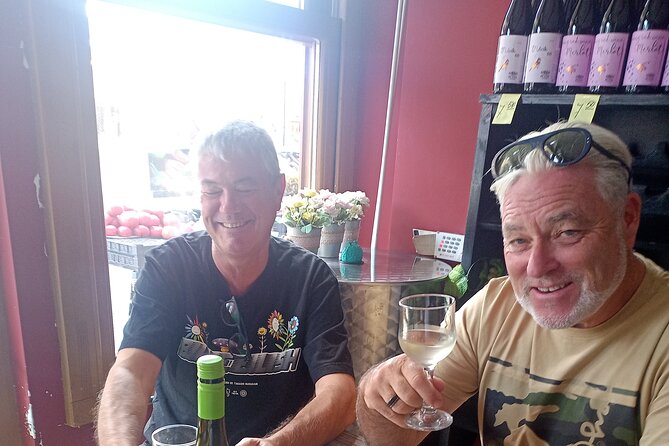
The food is not an afterthought. Five stops are included, with traditional meals and salad, breakfast, snacks, appetizers, and dessert listed as part of the experience.
The sample opening plate includes Bulgarian sausages and cheese with wine or beer. Later tastings can include dishes such as fried cheese, which pairs well with a cold beer and appeared as a memorable final stop for some tours. The exact food sequence can vary, so you should think of the menu as a broad promise of Bulgarian flavors rather than a fixed restaurant menu.
Bulgarian wine and beer are included, with a glass of local quality wine and Bulgarian beer available. That is a useful part of the value, since drinks can quickly raise the cost of an independent food crawl.
The servings are generous enough that you may finish full. If you want to try everything, arrive with an appetite and avoid a heavy meal beforehand. The tour suits curious eaters who like sampling several things, not people seeking one large restaurant dinner.
Dietary restrictions can be accommodated, including vegetarian, vegan, and gluten-free needs. You must state your requirements when booking. Since the tour involves shared foods and several stops, give clear details about allergies, especially if you need to avoid any of the listed allergens, including gluten, dairy, eggs, fish, mustard, nuts, sesame, soy, or sulphites.
Alcohol is not suitable for children aged 17 or under. The food itself may suit a mixed-age group, but the included beer and wine make this more naturally suited to adults.
The communist-era tram ride
The tram ride gives the tour a different feel from a standard walking route. It offers a look at Sofia’s transport culture and creates a welcome pause between stretches on foot. One especially practical feature is flexibility in hot weather. Peter has used the tram to get people out of the heat during a summer walk.
The tour is described as including communist-era tram culture, but the exact route, tram line, and length of the ride are not specified. You should not book it expecting a dedicated railway museum visit or a long transport-history program. Think of it as one part of a wider food and city walk.
The tram also helps break up the rhythm. Three hours can feel long when you are walking, eating, and listening at the same time. A short ride gives your feet a rest and lets you see a little more of Sofia as a lived-in city.
Price, timing, and practical value
At $91.07 per person, this is not the cheapest way to eat in Sofia. Bulgaria can be good value for independent dining, so a confident visitor could spend less by ordering at local restaurants and visiting the sights alone.
The price makes more sense when you count what is bundled together: five food stops, traditional meals, salad, appetizers, dessert, Bulgarian beer, local wine, guided sightseeing, the tram element, and a city card for the day. You are also paying for route planning and for Peter’s ability to connect food with architecture and history.
The tour lasts about three hours and includes travel time from place to place. Since the route moves through central Sofia, wear comfortable shoes and keep your schedule afterward reasonably open. The end point is the Central Market Hall of Sofia, on level -1, at 25 Knyaginya Maria Luiza Boulevard.
The starting point is the Patriarchal Cathedral of St. Alexander Nevsky in Sofia Center. Confirmation arrives at booking, mobile tickets are accepted, and the tour is offered in English. It is available near public transportation, and service animals are allowed.
Free cancellation is available if you cancel at least 24 hours before the start time. Changes or cancellations inside that window are not accepted for a refund.
Who will enjoy this Sofia experience
I would choose this tour for a first or second day in Sofia. It gives you a practical map of the center, introduces several neighborhoods and landmarks, and leaves you with ideas for food and drinks to try later.
It is especially suitable if you want:
- A small-group experience capped at 11 people
- A balance of sightseeing and eating
- Local beer and wine included in the price
- An introduction to Bulgarian food without planning several restaurants
- Historical context about Roman, Ottoman, religious, royal, and communist-era Sofia
- A guide who can adjust the route when the group is very small
You may prefer a different plan if you want a slow museum visit, a formal cooking class, or a fixed tasting menu with exact dishes announced in advance. The route covers plenty of ground, and the food stops are part of a moving city walk rather than a long sit-down meal.
Should you book Peter’s Sofia food tour?
Yes, if you want a lively first look at Sofia with enough food to replace a meal. Peter’s strongest quality is the mix of organization and personal attention. He explains the city clearly, adds local perspective, and knows how to keep the outing fun without turning it into a rushed checklist.
Book it early in your stay if you can. The tour is often reserved about four weeks ahead, and its value is greatest before you have formed your own plan for the city. Come hungry, mention dietary needs when booking, and allow time to revisit any sight that catches your interest.
FAQ
How long is the Sofia food and tasting tour?
The tour lasts approximately three hours, including travel time between stops.
Where does the tour begin?
It begins at the Patriarchal Cathedral of St. Alexander Nevsky, at Sofia Center, pl. Sveti Aleksandar Nevski, 1000 Sofia, Bulgaria.
Where does the tour end?
The tour ends at the Central Market Hall of Sofia, on level -1, at 25 Knyaginya Maria Luiza Boulevard.
How many food stops are included?
Five food stops are included.
What food and drinks are included?
The inclusions list traditional meals and salad, breakfast, snacks, appetizers, dessert, Bulgarian beer, and a glass of local wine. A sample starter includes Bulgarian sausages and cheese.
Is the tour available in English?
Yes. The tour is offered in English.
Can dietary restrictions be accommodated?
Yes. Vegetarian, vegan, gluten-free, and other dietary requirements can be accommodated if you provide the details in the special requirements field when booking.
Is the tram ride included?
Yes. The experience includes a communist-era tram ride or tram element, though the exact route and length are not specified.
What is the cancellation policy?
You can cancel for a full refund up to 24 hours before the experience start time. Cancellations or changes made less than 24 hours before the start time are not accepted for a refund.
More food experiences in Sofia
- Bulgarian Food tasting, cullinary-historical tour, Cooking class
★ 4.5 · 15 reviews - 3-Hour Private Bulgarian Food Tasting Tour of Sofia
★ 5.0 · 14 reviews - Cook and Eat with a Local in Sofia
★ 5.0 · 3 reviews - Private Sofia Tour with Unique Local Food & Drinks Experience
★ 4.5 · 3 reviews
Just added around Sofia
- Private Winter Day Trip to the Rila Mountain★ 4.5 · 3 reviews
- Transfer from Sofia to Stara Zagora★ 5.0 · 3 reviews
- Private 2 Hours Sofia Street Art and Graffiti Tour★ 5.0 · 3 reviews
- Tour to Koprivshtitsa and the Buzludzha monument incl the Seuthes Thracian Tomb★ 3.5 · 3 reviews
- Cook and Eat with a Local in Sofia★ 5.0 · 3 reviews
- Private Sofia Tour with Unique Local Food & Drinks Experience★ 4.5 · 3 reviews
- Koprivshtitsa and Starosel Tour★ 4.0 · 3 reviews
- Wine trip with The Jolly Vintners near Sofia★ 5.0 · 3 reviews
Food Tours in Sofia, compared.

Bulgarian Food tasting, cullinary-historical tour, Cooking class
Read our review →
3-Hour Private Bulgarian Food Tasting Tour of Sofia
Read our review →
Authentic Homemade Bulgarian Dessert Tasting in Sofia
Read our review →Browse the lists this tour appears in